

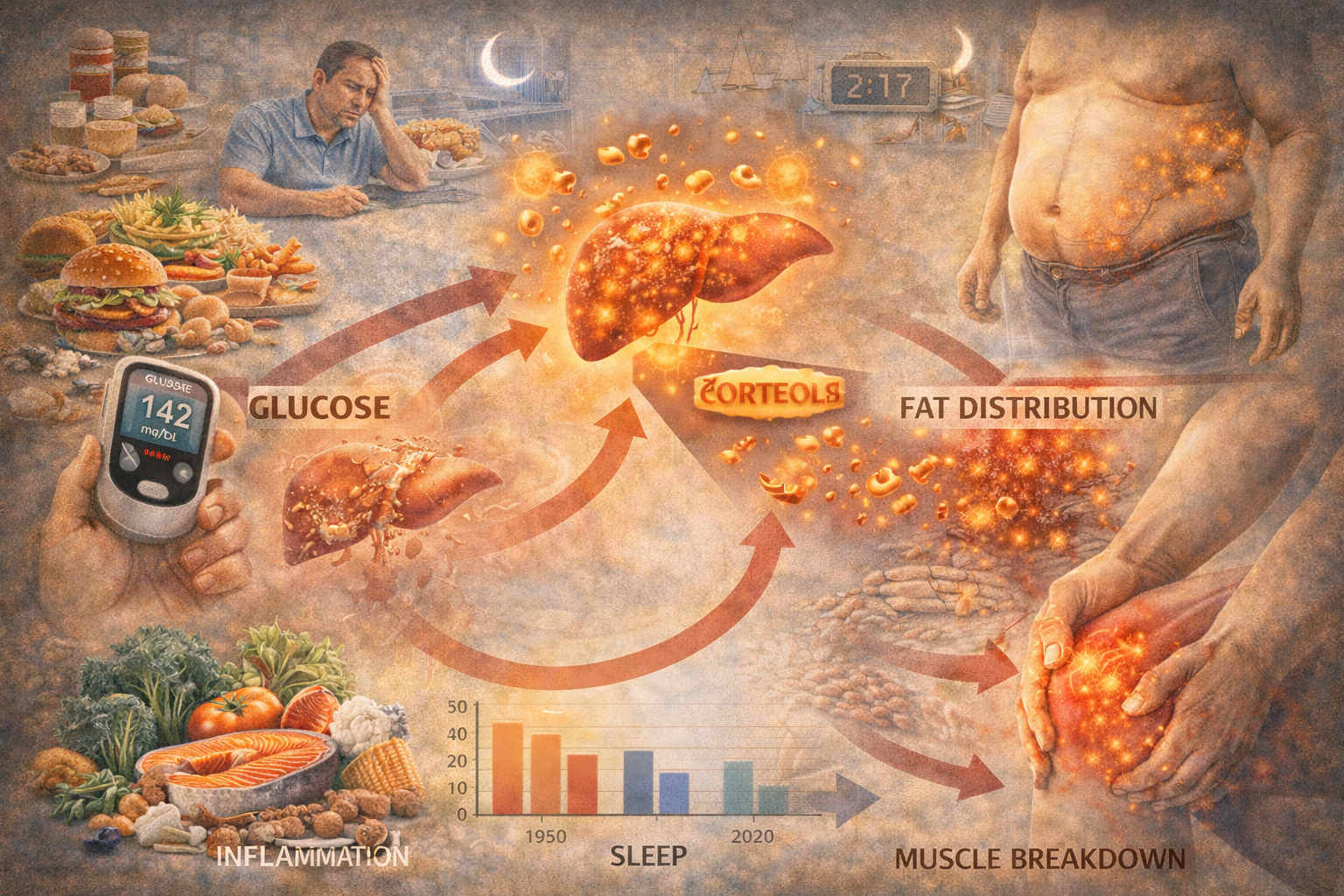
Cortisol has long been framed as the body’s primary stress hormone, often blamed for weight gain, fatigue, and burnout. In popular health discussions, it is frequently portrayed as something to suppress or “lower.” In reality, cortisol is neither inherently harmful nor optional. It is an essential hormone that plays a central role in survival, energy regulation, and metabolic adaptation. Problems arise not from cortisol itself, but from cortisol imbalance, a state in which the hormone’s rhythm, magnitude, or feedback control becomes disrupted.
As chronic metabolic disorders continue to rise globally, researchers are paying closer attention to how long-term cortisol dysregulation shapes metabolic health. Rather than acting as a single trigger, cortisol imbalance appears to function as a systems-level amplifier, influencing blood sugar regulation, fat distribution, muscle preservation, and inflammatory signaling over time.
Understanding cortisol’s role requires moving beyond simplified narratives and examining how modern lifestyles interact with an ancient hormonal system.
Cortisol’s Normal Role in Metabolism
Cortisol is produced by the adrenal glands in response to signals from the hypothalamic-pituitary-adrenal axis. Under healthy conditions, it follows a predictable daily rhythm. Levels peak in the early morning to promote alertness and mobilize energy, then gradually decline throughout the day, reaching their lowest point at night.
Metabolically, cortisol is designed to ensure fuel availability. It increases glucose production in the liver, supports fat mobilization, and helps maintain blood pressure during stress. In short bursts, this response is adaptive. It allows the body to respond to physical or psychological demands without compromising immediate survival.
Problems emerge when cortisol signaling becomes chronic, mistimed, or disconnected from actual energy needs.
What Cortisol Imbalance Really Means
Cortisol imbalance does not necessarily imply consistently high cortisol levels. In many cases, dysregulation involves altered timing, exaggerated responses to minor stressors, or blunted cortisol output following prolonged overactivation.
Research summarized by the National Institutes of Health indicates that chronic stress can disrupt feedback loops within the HPA axis. Over time, this may lead to persistently elevated cortisol, flattened daily rhythms, or inappropriate cortisol release in response to routine stimuli.
From a metabolic standpoint, any of these patterns can interfere with normal fuel regulation. The body may behave as though it is under constant threat, prioritizing short-term energy availability at the expense of long-term metabolic stability.
Cortisol and Blood Sugar Regulation
One of cortisol’s most significant metabolic effects is its influence on glucose. Cortisol stimulates gluconeogenesis, the process by which the liver produces glucose from non-carbohydrate sources. This mechanism is essential during fasting or acute stress, but when cortisol signaling is chronically elevated, it can contribute to sustained increases in blood sugar.
Over time, repeated glucose elevation places stress on insulin signaling pathways. Cells may become less responsive to insulin, setting the stage for insulin resistance. This relationship helps explain why chronic psychological stress is increasingly linked to metabolic disorders, even in the absence of excessive caloric intake.
The American Diabetes Association has noted that stress-related hormonal changes can complicate blood sugar management and may accelerate progression toward type 2 diabetes in susceptible individuals.
Fat Distribution and Cortisol Sensitivity
Cortisol does not affect all fat tissue equally. Certain fat depots, particularly visceral fat around the abdomen, express higher concentrations of cortisol receptors. This makes them more responsive to cortisol signaling.
When cortisol imbalance persists, fat storage may shift toward the abdominal region. This pattern is not merely cosmetic. Visceral fat is metabolically active and releases inflammatory mediators that further disrupt insulin sensitivity and lipid metabolism.
This feedback loop highlights how cortisol dysregulation can reshape body composition in ways that reinforce metabolic dysfunction. It is not simply about weight gain, but about where and how energy is stored.
Muscle, Metabolism, and Catabolic Signaling
Cortisol is a catabolic hormone, meaning it promotes the breakdown of stored tissues to release energy substrates. In the short term, this supports survival. Over the long term, excessive catabolic signaling can undermine metabolic health.
Chronic cortisol imbalance may contribute to muscle protein breakdown, particularly when combined with inadequate nutrition or poor sleep. Loss of lean muscle mass reduces resting metabolic rate and impairs glucose disposal, further increasing metabolic strain.
This mechanism helps explain why prolonged stress is often associated with weakness, reduced physical resilience, and difficulty maintaining metabolic health despite unchanged eating habits.

The Role of Sleep and Circadian Disruption
Sleep plays a critical role in regulating cortisol rhythms. Under normal conditions, cortisol declines at night to allow restorative processes to occur. Sleep deprivation or irregular sleep schedules disrupt this pattern.
Harvard Health Publishing reports that even short-term sleep loss can elevate evening cortisol levels, interfering with insulin sensitivity and appetite regulation the following day. Over time, circadian disruption may flatten cortisol rhythms altogether, eliminating the clear distinction between active and restorative phases.
In a society characterized by late-night screen exposure, shift work, and irregular schedules, this form of cortisol imbalance has become increasingly common.
Diet, Energy Perception, and Cortisol
Dietary patterns influence how the body interprets stress. Severe caloric restriction, erratic eating schedules, or prolonged underfueling can all be perceived as stressors, activating cortisol release.
At the same time, diets high in refined carbohydrates may amplify cortisol’s glycemic effects, leading to repeated blood sugar spikes and crashes. These fluctuations can themselves trigger additional stress responses, creating a cyclical pattern of hormonal activation.
Educational resources focused on metabolic health, such as those found on Dr. Berg’s website, often emphasize aligning diet with hormonal signaling rather than treating hormones in isolation. From this perspective, cortisol imbalance reflects a mismatch between energy availability, perception of threat, and recovery capacity.
Cortisol, Inflammation, and Long-Term Risk
Cortisol is often described as anti-inflammatory, and in acute settings, this is accurate. However, chronic cortisol dysregulation appears to have the opposite effect. Prolonged exposure can impair immune regulation, leading to increased inflammatory signaling.
Low-grade inflammation is a common feature of metabolic disorders, cardiovascular disease, and neurodegenerative conditions. When cortisol feedback mechanisms fail, the immune system may oscillate between suppression and overactivation, neither of which supports long-term health.
This complexity underscores why cortisol cannot be categorized as simply “good” or “bad.” Its impact depends on timing, context, and duration.
A Hormonal System Under Modern Pressure
Cortisol evolved to manage intermittent, short-lived stressors. Modern life, by contrast, exposes individuals to persistent psychological, environmental, and metabolic stress without corresponding recovery periods.
The result is a hormonal system that remains activated long after the original stressors would have resolved in ancestral environments. Cortisol imbalance, in this sense, is not a personal failure but a predictable response to a chronic mismatch between biology and lifestyle.
Recognizing this helps shift the conversation away from symptom suppression and toward systemic recalibration.
Cortisol dysregulation sits at the intersection of stress physiology and metabolic health. Its effects are subtle, cumulative, and deeply interconnected with other hormonal systems. Rather than acting as a single cause, cortisol imbalance amplifies existing vulnerabilities and accelerates metabolic decline over time.
As hormone research continues to evolve, cortisol is increasingly viewed as a signal of overall system load rather than an isolated target. Addressing its imbalance requires attention to sleep, nutrition, recovery, and environmental stressors, not just pharmacological intervention.
In this broader framework, cortisol becomes less of a villain and more of a messenger. Understanding what it is responding to may be one of the most important steps toward restoring long-term metabolic health.