

|
What this covers
|
The home office did not arrive once. It arrived three times, and each arrival optimized for something different. Furniture bought in the first wave is frequently wrong for the third, which is why a lot of houses contain a desk that nobody is happy with and nobody can quite justify replacing.
Phase One: Whatever Was Already in the House
The first phase was not a buying phase. It was an improvisation phase.
Kitchen tables, dining chairs, ironing boards, a laptop on a stack of books. The constraint was time, not money, and the assumption underneath every arrangement was that it was temporary. Nobody measures a dining chair against a desk height when the arrangement is expected to last six weeks.
What this phase optimized for was speed of setup. Everything else was deferred.
Phase Two: The Panic Purchase
Phase two started when temporary stopped looking temporary. Buying began in earnest, and it was shaped by three things: limited stock, limited information, and a strong desire to stop working at the kitchen table.
The purchases from this phase share a signature. They are usually full-size, usually permanent, and usually bought on specification rather than on fit. Width, height range, weight capacity. The questions a person asks when they are replicating an office.
That was a reasonable instinct and it carried an assumption that did not survive: that the desk would have a room.
The Spare Room Was Never the Normal Case
A great deal of home office advice written in that period assumes a dedicated room. Close the door, separate work from home, set up properly.
For a large share of households that room does not exist. The desk goes in a bedroom, a living room corner, a hallway or a studio apartment that has no separate rooms at all. In those cases the desk is not furnishing an office. It is occupying part of a room that already had a job.
This is where phase-two purchases started to chafe. A full-size desk in a dedicated office is invisible. The same desk in a bedroom is a piece of office furniture a person sleeps next to.
Phase Three: Hybrid Turns the Desk Into a Part-Time Object
The third change is the one still working through, and it is the most consequential for furniture.
A hybrid schedule means the home desk is used on some days and not others. That sounds minor. It is a category change. A desk that is used every day is infrastructure, and infrastructure is allowed to take up space. A desk that is used two or three days a week is a part-time object taking full-time floor space.
|
Working pattern |
What the desk is |
What matters most |
|
Fully in office |
Not present |
n/a |
|
Fully remote, dedicated room |
Infrastructure |
Ergonomics, size, adjustability |
|
Fully remote, shared room |
Infrastructure with a visual cost |
Ergonomics and appearance |
|
Hybrid, shared room |
Part-time object |
Footprint when not in use |
The bottom row is the fastest-growing case and it is the one phase-two furniture handles worst. A desk optimized for an eight-hour day is being judged on what it does during the other sixteen, and on the days nobody works at it at all.
What That Did to the Product Question
The question people ask when shopping has visibly shifted. Earlier it was about height range, worktop size and motor speed. Increasingly it is about what the desk does with itself when work is finished.
That produces different designs. Folding mechanisms, wall-mounted drop-leaves, desks on casters that move out of the way, and desks that descend to floor level so the working position can be floor-based and the room reads as a room rather than as an office.
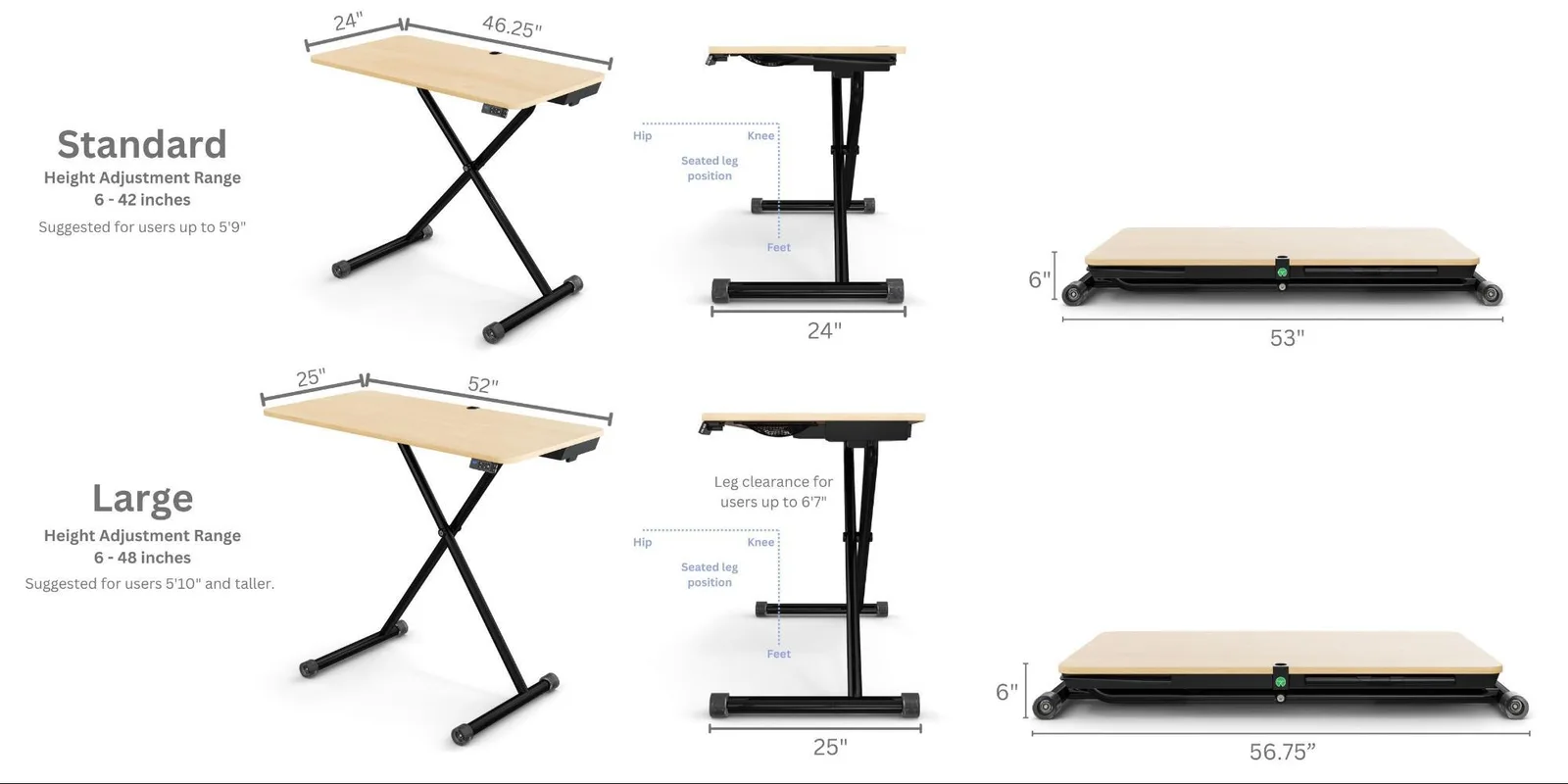
The floor-level end is the least familiar of those in Western markets and the most space-efficient, because a working position at floor height does not need a chair, and the chair is frequently a larger footprint problem than the desk. Companies working that end of the market, Lillipad among them, build height adjustable sit to stand desks with a travel that reaches floor height as well as standing height, which is a wider span than conventional office furniture attempts.
What the Return-To-Office Wave Did Not Undo
A reasonable prediction in 2023 was that office returns would shrink this category back toward where it started. That has not happened, for a structural reason.
Hybrid is not a halfway house between two states. It is a third state with its own requirements, and it requires a home setup that exists permanently while being used intermittently. A person in the office three days a week still needs a working position at home on the other two, and still has to live with that position seven days a week.
The requirement did not go away. It changed shape, from a full-time office to a part-time workstation with a full-time space cost.
What Each Phase Got Wrong, and What It Got Right
Worth being fair to all three, because each was a reasonable response to the information available.
|
Phase |
Got right |
Got wrong |
|
Improvisation, 2020 |
Speed. Work continued |
Assumed it was temporary, so nothing was measured |
|
Panic purchase, 2021 to 2022 |
Took ergonomics seriously for the first time |
Assumed a dedicated room, and bought office-sized |
|
Hybrid adjustment, 2023 onward |
Treats the room as shared and the desk as part-time |
Still buying against specifications written for phase two |
The third row is the live problem. The requirement changed faster than the product category did, so a great deal of what is currently sold is still answering the phase-two question of how to replicate an office, while the phase-three question is how to put a workstation in a room that already has a purpose.
That lag shows up in how products are described. Listings lead with height range, motor speed and worktop area. The questions people are actually asking are about folded size, storage, appearance and whether the thing can be got out of the way, and those answers are often not on the page at all.
What This Means for Somebody Buying Now
A short list, aimed at the current situation rather than the 2020 one.
- Decide what the room is when nobody is working. That is the constraint, and it is the one that gets skipped.
- Count the chair. A desk’s footprint on paper rarely includes the chair, and the chair plus clearance is often the larger number.
- Check the lower end of the height range, not just the upper. The top of the travel is well covered across the market. The bottom is where the designs diverge.
- Be realistic about how many days a week it is used. A two-day-a-week desk and a five-day-a-week desk are not the same purchase.
- Assume the arrangement is permanent. The thing phase one got wrong was treating it as temporary. Most of these setups are now years old.
The common thread across all three phases is that each one solved the previous phase’s problem and inherited a new constraint it had not seen yet. Anybody buying now is buying into phase three, and the honest question is which of its assumptions will look wrong in two years.
The Furniture That Aged Worst, and Why
A useful exercise for anybody about to buy: look at which phase-two purchases people are now trying to get rid of.
The pattern is consistent. The items being replaced are the large, fixed, office-looking ones. Wide corner desks, heavy pedestal units, high-backed mesh task chairs in black. Not because any of them is badly made, but because every one was designed to look correct in an office, looks wrong in a living room, and does not get smaller when the working day ends.
What survives is smaller, more domestic in appearance, and either movable or foldable.
|
Bought in phase two |
Why it is being replaced now |
|
Wide corner desk |
Occupies a corner the room needs for something else |
|
Pedestal drawer unit |
Storage used only two days a week |
|
Large task chair |
Reads as office furniture and cannot be stored |
|
Fixed-height office desk |
Cannot be put away, and was never adjustable |
The lesson for a current buyer is not that the phase-two purchases were foolish. It is that furniture bought to look like an office ages badly in a home, and furniture bought to look like furniture does not.
Where It Appears to Be Heading
The direction of travel is away from replicating an office at home and toward furniture that is honest about sharing a room. Less emphasis on matching corporate specification, more on footprint, storage and whether the thing can disappear.
That is a smaller, more domestic design problem than the one the category started with, and it is a better fit for how most people are actually working now. The desk stopped being an office. It became a piece of furniture that works for part of the week, and furniture gets judged on all seven days.