

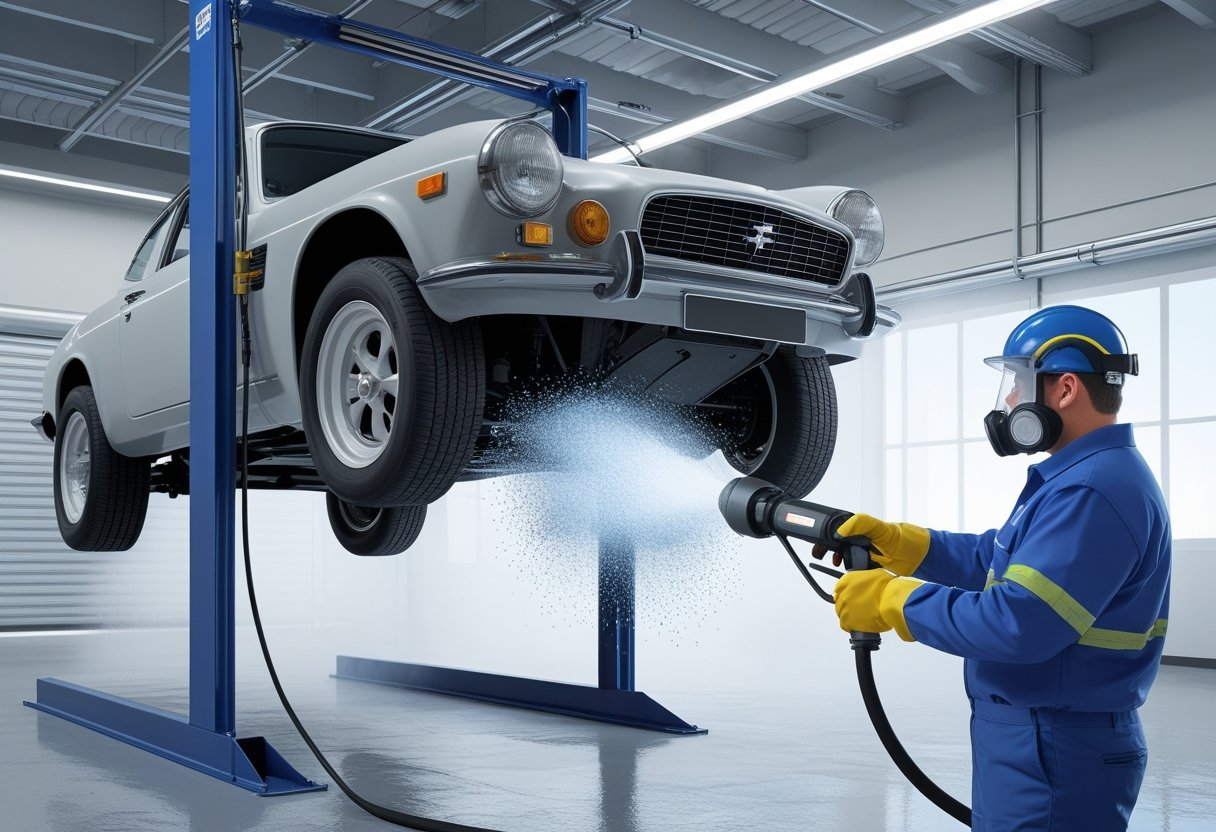
Removing rust and road grime from vehicle undercarriages presents ongoing challenges for automotive professionals, particularly when dealing with sensitive surfaces, intricate components, and the risk of extended downtime. Traditional abrasive, wet, or chemical cleaning methods can introduce secondary waste, surface damage, or corrosion risks. Nu-Ice Blasting™ manufactures advanced dry ice blasting equipment designed as a non-abrasive and environmentally responsible alternative. Using recycled CO₂ in solid form, dry ice blasting undercarriage applications can safely lift surface rust and accumulated road debris without harming underlying materials. This approach supports dry ice rust removal car processes and dry ice auto restoration projects, including historic restorations where preserving original substrates is critical.
Dry ice blasting is a cleaning process that uses solid carbon dioxide (CO₂) pellets propelled by compressed air to remove contaminants from surfaces. The system feeds dry ice pellets through a blasting unit, where they are accelerated through a hose and nozzle toward the targeted area. Upon impact, the pellets loosen surface contaminants and immediately sublimate—transitioning from solid to gas—without leaving liquid residue. Because the dry ice converts directly into CO₂ gas, there is no secondary blasting media to collect or dispose of. This makes the process suitable for applications requiring reduced cleanup, minimal downtime, and preservation of underlying materials.
Kinetic Impact
Dry ice pellets are accelerated by compressed air and directed at the surface. The velocity of the pellets helps loosen contaminants from the substrate without the abrasion associated with traditional media.
Thermal Shock
Dry ice is extremely cold. When pellets contact a warmer surface, the temperature differential can cause contaminants to contract and weaken their bond to the underlying material.
Sublimation Expansion
Upon impact, dry ice rapidly transitions from solid to gas. This expansion helps lift and dislodge loosened contaminants from the surface, while the blasting media itself dissipates into the atmosphere.
A dry ice blasting system consists of several essential components that work together to deliver controlled cleaning performance.
Air Compressor – Supplies the compressed air required to propel dry ice pellets through the system at adjustable pressure levels.
Dry Ice Hopper – Stores the dry ice pellets prior to use, maintaining a consistent feed into the blasting unit.
Metering System – Regulates the amount of dry ice introduced into the airflow, allowing operators to control cleaning intensity and media consumption.
Hose and Nozzle – Direct the air and pellet mixture toward the surface, focusing the stream for targeted application and operational precision.
Founded in 2012, Nu-Ice Blasting™ is a U.S.-based manufacturer of dry ice blasting equipment. The company designs and builds its machines in the United States, focusing on industrial-grade cleaning systems that use solid CO₂ pellets as the blasting media. Nu-Ice Blasting™ equipment is engineered to support a range of applications where non-abrasive cleaning is required, including automotive, manufacturing, and restoration environments. In automotive contexts such as dry ice rust removal car projects, the equipment enables controlled surface treatment without introducing additional blasting media waste. By manufacturing its systems domestically, Nu-Ice Blasting™ maintains oversight of production processes and component integration. The company’s equipment is designed for operational efficiency, portability, and consistent media delivery in industrial cleaning settings.
Nu-Ice Blasting™ systems incorporate several integrated components that support controlled operation. The blasting gun is designed for operator handling and connects to interchangeable nozzle options, allowing adjustment of the discharge pattern depending on surface access and application requirements. Different nozzle configurations help focus or widen the pellet stream for targeted cleaning.
The systems also include an integrated moisture separator and aftercooler. The moisture separator functions to remove water vapor from the compressed air supply before it enters the machine. The aftercooler helps reduce air temperature after compression, contributing to consistent airflow conditions. Together, these components support stable pellet flow and controlled blasting performance during operation.
Nu-Ice Blasting™ machines are built in compact, mobile configurations suitable for industrial environments. Typical system dimensions are designed to allow maneuverability in workshops and production settings, with unit weights engineered for portability while maintaining structural durability. Hopper capacity supports a consistent supply of dry ice pellets during operation, reducing the need for frequent refilling.
The systems operate within defined airflow and pressure ranges that allow operators to adjust blasting intensity depending on application requirements. Airflow capacity is compatible with industrial air compressors, while pressure ranges are adjustable for controlled surface treatment. Dry ice consumption rates vary based on settings and application demands, enabling operators to regulate pellet usage during cleaning processes.
Preparation and Setup
The process begins by connecting the dry ice blasting unit to a suitable compressed air source. Dry ice pellets are loaded into the hopper, and airflow and feed settings are adjusted according to application requirements. Hoses and nozzle attachments are secured before operation.
Safety Requirements
Operators follow standard industrial safety practices, including appropriate ventilation, personal protective equipment, and safe handling of compressed air systems and dry ice media.
Typical Workflow Steps
Once activated, compressed air propels the dry ice pellets through the metering system and hose assembly toward the targeted surface. Operators guide the blasting gun methodically across the work area, maintaining controlled distance and motion until cleaning procedures are complete.
Nu-Ice Blasting™ equipment is used across a variety of industrial and commercial sectors where controlled, non-abrasive cleaning is required. In manufacturing and production environments, systems are utilized for maintenance cleaning of machinery, molds, tooling, and equipment components.
Within food processing and sanitation settings, dry ice blasting systems are applied to equipment surfaces where dry cleaning methods are preferred. The process does not introduce additional blasting media, supporting maintenance procedures in regulated environments.
For historical restoration and delicate surface applications, the equipment is used in projects where preservation of underlying substrates is essential. This includes architectural restoration and specialty conservation work.
Automotive, aerospace, and electrical industries also incorporate dry ice blasting systems for cleaning parts, assemblies, and sensitive components. The equipment is used in specialty cleaning scenarios where traditional abrasive or wet methods may not be suitable.
Dry ice blasting is characterized by the absence of secondary blasting media, as the dry ice sublimates upon impact. This eliminates additional cleanup associated with sand, grit, or liquid residues. The process is non-abrasive when properly configured, allowing interaction with surfaces without grinding or etching.
Because the system uses solid CO₂ pellets and compressed air, the process remains dry and does not rely on chemical solvents. In applications such as dry ice auto restoration, including dry ice blasting undercarriage procedures, these operational characteristics support surface preparation and maintenance workflows. Environmental and handling considerations include appropriate ventilation and adherence to compressed air system guidelines during equipment operation.
Nu-Ice Blasting™ systems support interchangeable nozzle and hose options designed to accommodate different operational requirements and surface access needs. Nozzle configurations allow operators to adjust the discharge pattern, while hose assemblies connect the blasting gun to the main unit for controlled media delivery.
System integration requires a compatible compressed air supply, and the use of aftercoolers and moisture separators helps condition the air before it enters the blasting machine. Proper storage of dry ice pellets and routine maintenance of hoses, fittings, and internal components support consistent system operation over time.
Frequently Asked Questions (FAQs)
What is dry ice blasting?
Dry ice blasting is a cleaning method that uses solid carbon dioxide (CO₂) pellets propelled by compressed air. The pellets impact the surface and sublimate from solid to gas, assisting in the removal of contaminants without leaving secondary blasting media.
Is the equipment compatible with standard industrial air compressors?
Nu-Ice Blasting™ systems are designed to operate with industrial compressed air supplies within specified airflow and pressure ranges. A properly sized compressor is required to ensure consistent pellet acceleration and system performance.
What safety considerations are involved?
Operators should follow standard industrial safety practices, including appropriate ventilation, personal protective equipment, and proper handling of compressed air systems and dry ice. Adequate airflow is important due to the release of CO₂ gas during operation.
What infrastructure is required to operate the system?
Operation requires access to a compatible air compressor, appropriate power supply where applicable, and sufficient workspace ventilation. Storage space for dry ice pellets and clearance for maneuvering the equipment are also necessary.
How does dry ice blasting compare to abrasive methods?
Unlike traditional abrasive blasting, dry ice pellets sublimate upon impact, meaning no additional blasting media remains after cleaning. The process does not rely on sand, grit, or liquid agents that may require separate disposal procedures.
Does the process introduce chemicals or moisture?
Dry ice blasting uses solid CO₂ pellets and compressed air. The process remains dry and does not rely on added chemical solvents or water-based cleaning agents.
What environmental considerations apply?
Because the dry ice converts directly into gas during use, there is no secondary blasting media to collect. Proper ventilation is necessary to manage CO₂ levels, particularly in enclosed or industrial environments.
As industries continue to evaluate alternatives to abrasive and chemical cleaning methods, dry ice blasting equipment remains a consideration for operations requiring controlled surface treatment and reduced secondary waste. Since its founding in 2012, Nu-Ice Blasting™ has manufactured dry ice blasting systems in the United States for industrial and commercial applications. The company’s equipment is designed to integrate with standard compressed air infrastructure while supporting dry, non-abrasive cleaning processes across manufacturing, restoration, automotive, and specialty environments. By focusing on equipment manufacturing and system design, Nu-Ice Blasting™ contributes to the broader adoption of dry ice blasting technology in settings where surface preservation, operational efficiency, and controlled media delivery are operational priorities.