

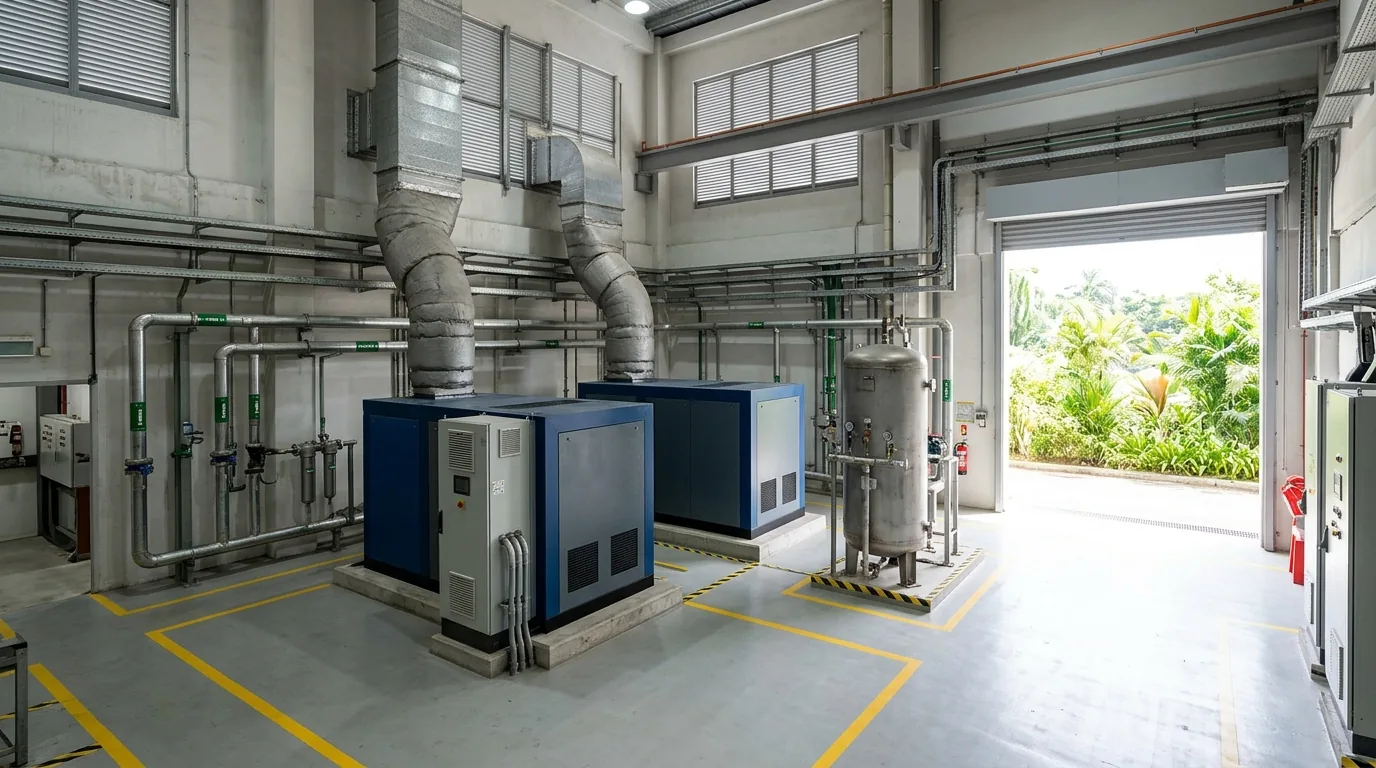
Compressed air is often described as free because it is drawn from the atmosphere, and treated as a simple utility because it arrives at the turn of a valve. Neither impression survives a look at the electricity bill or a day without it. An industrial air compressor singapore factories rely on is among the larger single consumers of power on site and a point of failure for everything downstream. Understanding how these systems behave is worth the effort before buying, expanding or replacing one.
Compressed Air as the Fourth Utility
Alongside electricity, water and gas, compressed air powers tools, actuators, conveying, packaging and instrumentation across manufacturing, marine, construction and food processing. Its appeal is safety and simplicity at the point of use. Its drawback is inefficiency at the point of generation, since most of the electrical energy put into a compressor is released as heat. That trade-off shapes every sensible decision about system design, from machine selection to how far the air must travel.
The Main Compressor Types
Rotary screw compressors dominate industrial use because they deliver steady flow for long running hours. Piston compressors remain common in small workshops with intermittent demand. Scroll units serve low-flow, low-noise applications such as laboratories. Centrifugal machines supply very large volumes for process plants. Each has a range in which it is efficient and outside which it is not, so the right type follows from the demand pattern and not from habit or the lowest initial price.
Flow, Pressure and Power
Three figures describe what a compressor does. Flow, usually quoted as free air delivery, is the volume of air supplied. Pressure is the force at which it is delivered, and it must cover the highest requirement on site plus the losses in treatment and pipework. Motor power indicates the size of the machine but says little about efficiency. Specific power, the energy used per unit of air delivered, is the figure that allows two machines to be compared fairly at the same working pressure.
Oil-Lubricated or Oil-Free
Lubricated screw compressors inject oil to seal, cool and protect the rotors, then separate most of it before discharge. Trace amounts remain and are handled by downstream treatment. Oil-free machines keep lubricant out of the compression chamber altogether. They cost more to buy and maintain, and are specified where any contamination risk is unacceptable. Lubricated units still depend on the industrial air filter singapore production lines need, sized and maintained correctly, to deliver air of the required purity.
Fixed Speed and Variable Speed
A fixed-speed compressor runs at full output or idles unloaded, drawing significant power while producing nothing. That suits a steady base load. A variable-speed drive adjusts motor speed to match demand and saves energy where consumption rises and falls through the day. It is not a universal answer: at constant full load, the drive’s own losses make it slightly less efficient. Larger sites often combine a fixed-speed base machine with a variable-speed unit to follow the swings.
Sizing to Real Demand
Capacity should be based on measured consumption wherever possible. Adding up the nameplate figures of every tool overstates the requirement, because equipment rarely runs simultaneously. Too small a compressor causes pressure drops; too large a one cycles wastefully. System pressure deserves equal care. Each increment of pressure above what the process needs costs additional energy, so setting the compressor to satisfy one demanding user penalises the entire plant. A local booster is frequently the better remedy.
Heat, Humidity and Ventilation
Singapore’s climate works against compressors in two ways. High ambient temperature reduces air density and stresses cooling systems, while high humidity increases the water that must be removed after compression. A compressor room needs enough airflow to carry away the heat rejected by the machines, with intake and exhaust arranged so that hot air is not recirculated. Dryers and drains should be sized for tropical conditions and not for the temperate ratings quoted in many catalogues.
Leaks and Distribution Losses
A share of the air produced in most plants never reaches a useful application. It escapes through worn couplings, hose joints, valve stems and drains left open. Leaks are continuous, so small ones add up to a considerable energy cost over a year. Undersized or corroded pipework adds pressure drop. Periodic leak surveys using ultrasonic detection, prompt repairs and a properly sized ring main usually recover capacity more cheaply than buying another compressor.
Maintenance and Statutory Duties
Screw compressors need scheduled changes of lubricant, air and oil filters and separator elements, plus periodic checks of coolers, belts or couplings and safety valves. Neglect shows up first as rising energy use and temperature, then as failure. Air receivers are pressure vessels subject to registration and periodic examination under workplace safety rules. A capable air compressor supplier in singapore will build these tasks into a service plan and keep the records an inspection requires.
How to Approach the Decision
Start by measuring current demand and pressure across a normal week, then fix leaks and correct pressure settings before deciding how much new capacity is needed. Define the air quality each process requires. Ask suppliers to propose a complete system with stated specific power and a five-year cost including electricity and service. Choose the configuration with the lowest whole-life cost that leaves reasonable room for growth, and confirm local service support before signing.