

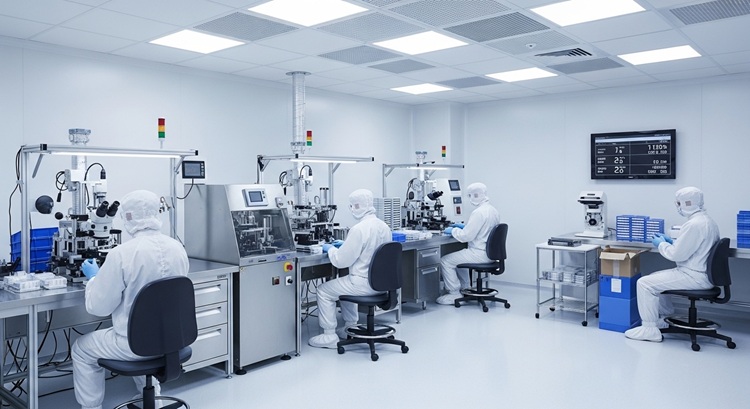
A clean room for medical devices is not something that forgives poor planning. Unlike many built environments, where design flaws can be patched, repainted, or worked around, a contamination-controlled facility carries its mistakes forward in ways that compound over time. A poorly positioned airlock, an undersized HVAC system, or a surface material chosen without thought for particle shedding will not simply cause inconvenience. These errors will undermine the entire environmental control strategy and, in doing so, compromise the safety of the products manufactured within. The history of medical device clean room design is, in part, a history of lessons learned the hard way.
Starting With the Wrong Classification
One of the most consequential mistakes made during the design of a clean room for medical device manufacturing is selecting an ISO classification that does not match the actual manufacturing risk profile. Classification decisions are sometimes driven by cost minimisation rather than product requirement analysis, which leads to facilities that are either overbuilt for their purpose or, more dangerously, underbuilt.
ISO 14644-1 provides a clear framework. ISO Class 5 is appropriate for the most sensitive operations, such as the assembly of implantable devices with exposed sterile pathways. ISO Class 7 and Class 8 suit less critical assembly steps and secondary packaging. The mistake occurs when manufacturers assume a single classification will serve all operations within a facility, ignoring the need for zoned environments that reflect the varying contamination sensitivity of different production stages.
Singapore’s medical device cleanroom sector has largely moved beyond this error, with purpose-built facilities designed from the outset with progressive zoning, allowing movement through progressively cleaner environments as products reach their most sensitive assembly stages.
Underestimating Airflow Engineering
A clean room facility for medical devices lives or dies by its airflow. This is not a metaphor. Contamination in a controlled environment is governed almost entirely by the behaviour of air, and air behaves in ways that are counterintuitive without proper modelling and engineering expertise.
Common airflow design mistakes include:
- Insufficient air change rates for the intended ISO classification and occupancy level
- Placement of supply air diffusers and return air grilles that creates turbulence rather than laminar flow
- Inadequate pressurisation differentials between zones, allowing cross-contamination during door openings
- Failure to account for heat loads from equipment, which disrupts planned airflow patterns
- No provision for future equipment additions that may alter air movement within the space
Computational fluid dynamics modelling, while an additional upfront investment, is now standard practice in well-designed medical device clean room facilities and can identify these problems before construction begins rather than after commissioning.
Choosing the Wrong Materials
The surfaces inside a clean room for medical devices must be smooth, non-porous, chemically resistant, and incapable of shedding particles under routine cleaning conditions. This sounds straightforward. In practice, it is an area where cost-cutting decisions routinely create long-term problems.
Mistakes in material selection include:
- Standard painted drywall, which deteriorates under repeated disinfectant contact and begins shedding particles within months
- Conventional floor coatings that crack at joints and harbour microbial contamination
- Ceiling tile systems designed for office environments rather than contamination-controlled spaces
- Exposed fasteners and unfinished edges that accumulate particulate and resist cleaning
- Inadequate cove detailing at wall-floor junctions, creating ledges where contamination collects
The materials used in a clean room medical device manufacturing environment must be selected with a full understanding of the cleaning agents that will be used against them and the frequency with which that cleaning will occur.
Ignoring Personnel Flow
The movement of people through a medical device clean room is a contamination event. Every entry, every transition between zones, and every exit carries risk if the facility has not been designed to manage that movement systematically.
Design mistakes in this area are surprisingly common:
- Gowning rooms that are too small to allow proper sequential gowning without cross-contamination between clean and dirty sides
- Airlocks designed without interlocking door controls, allowing both doors to open simultaneously
- Insufficient space for the number of personnel required during peak production shifts
- No separation between entry and exit pathways, creating bidirectional contamination risk
- Inadequate handwashing and gowning material storage provision
Singapore’s clean room for medical device facilities have set a regional benchmark for personnel flow design, with many newer facilities incorporating single-direction traffic patterns and dedicated material transfer airlocks that prevent personnel and product pathways from intersecting.
Neglecting Utility Integration
A clean room for medical device production requires utilities, including compressed gases, electrical systems, process water, and waste removal, that must be integrated without compromising the envelope’s contamination control. Penetrations through walls and ceilings are among the most common sources of ongoing compliance problems in operational facilities.
Every penetration must be sealed to the same standard as the surrounding surface. Every utility connection must be designed for cleanability. Every piece of overhead equipment, from lighting to fire suppression systems, must be selected and installed to avoid particle generation and ledge accumulation.
Documentation of Design Intent
A final and often overlooked mistake is the failure to document the design intent of the facility clearly enough to support future change control. When the basis for an airflow configuration, a surface material choice, or a pressure differential is not recorded, subsequent modifications are made without understanding what they may disturb.
Conclusion
The errors made during the design of a Clean room for medical devices rarely announce themselves immediately. They surface during commissioning, during routine monitoring, or during regulatory inspections, at which point correction is expensive and disruptive. Avoiding these mistakes requires treating design not as a cost to be minimised but as the first and most important act of quality assurance in the life of a clean room for medical devices.