

Architecture firms have a harder web problem than most professional services businesses, and it is not a shortage of taste. It is the opposite. The work is visual, the photography is expensive, and the instinct to present it at full strength is correct in every way except one.
The exception is that the browser has to download all of it.
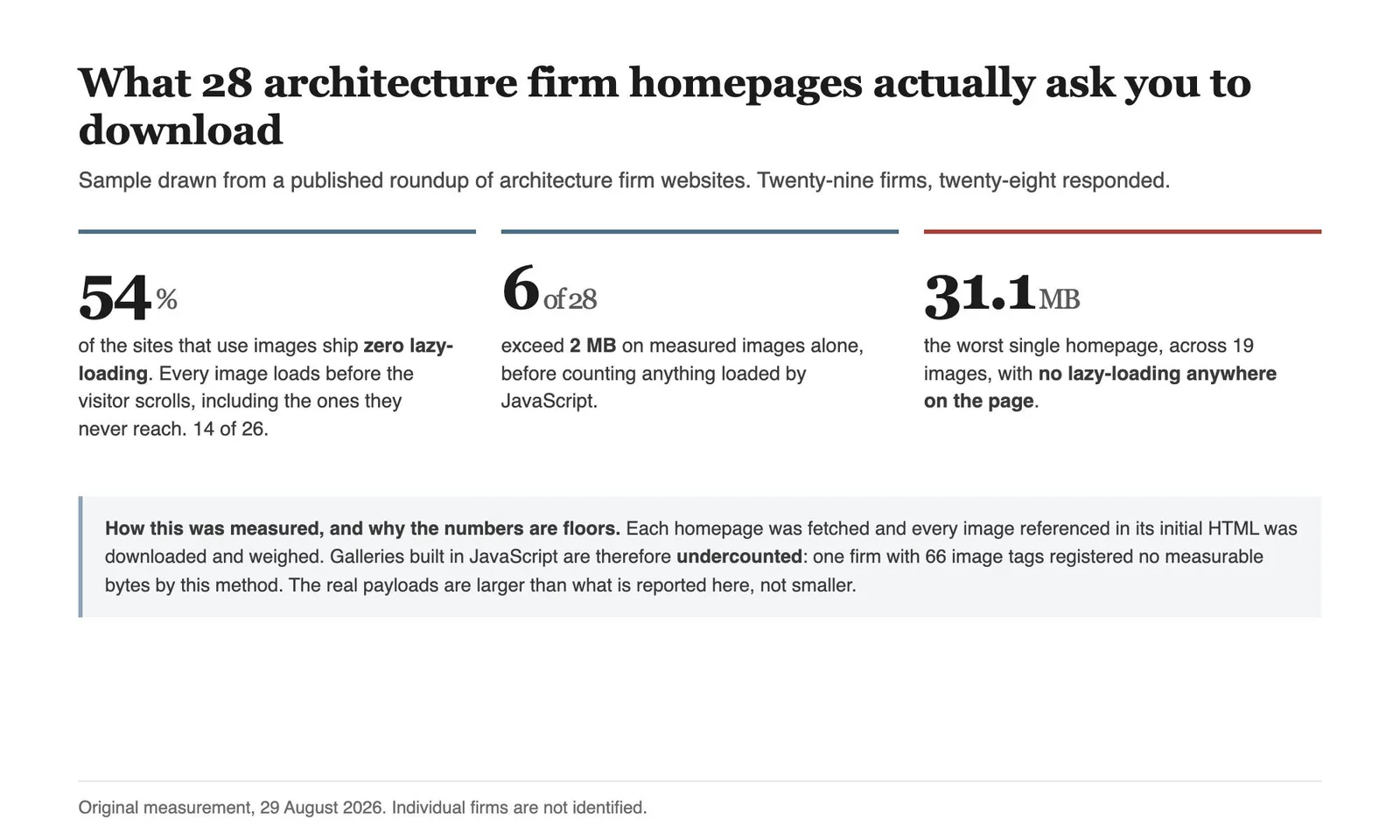
We wanted to know how bad that actually gets in practice, so we measured it. We took a published roundup of architecture firm websites, pulled 29 firm homepages from it, and recorded what each one asks a visitor to download. Twenty-eight responded.
What the measurement found
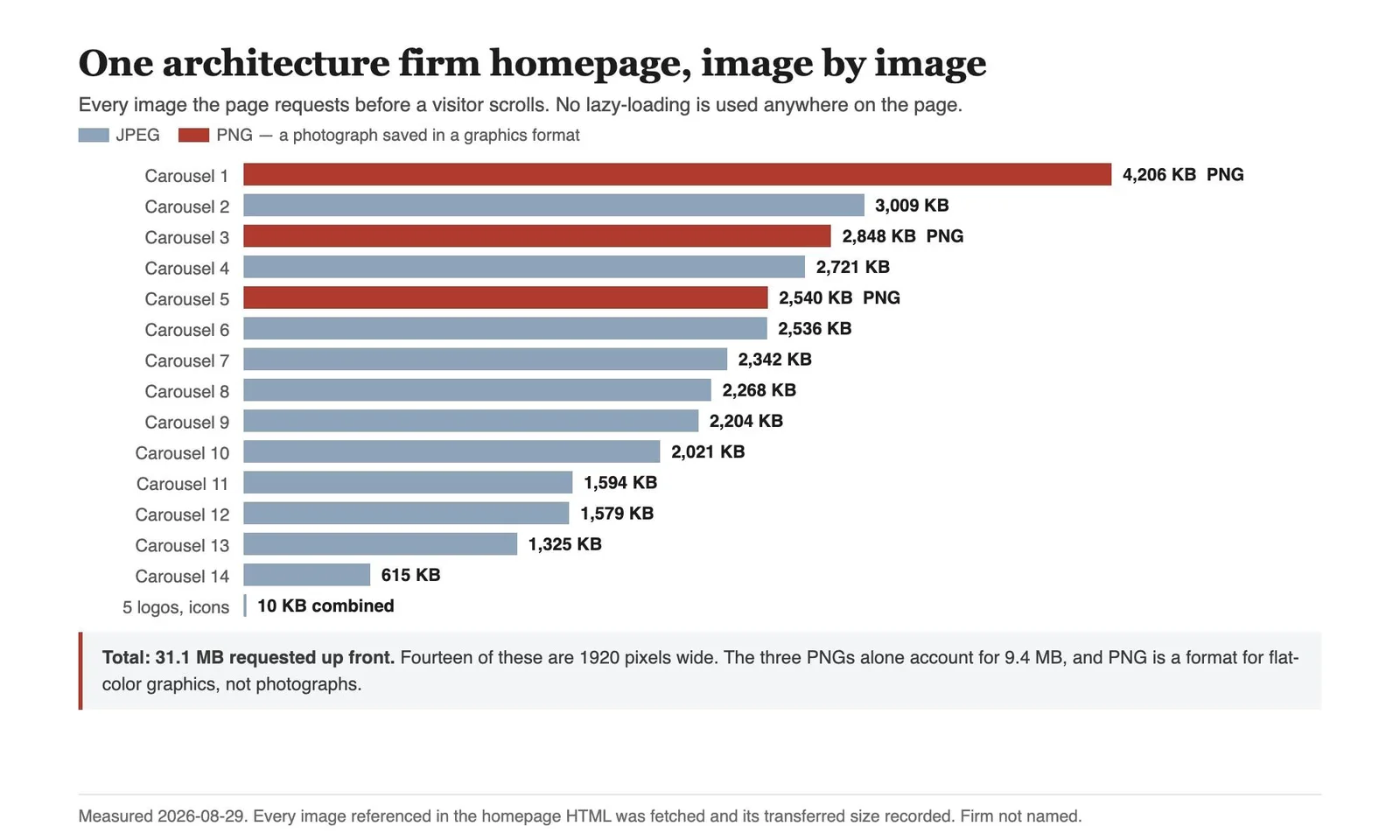
The single worst case was a firm whose homepage requests 31.1 megabytes of imagery across its first 19 images, with no lazy-loading anywhere on the page.
That is not a typo and it is not an unusual firm. It is a well-regarded practice with beautiful work, and the site is showing that work the way an architect would want it shown: a full-bleed carousel of large, high-resolution photographs. Fourteen of those images are 1920 pixels wide. Several of them are PNGs, one at 4.2 megabytes and another at 2.8, and the PNG detail matters because PNG is a format for graphics with flat color and hard edges. For a photograph it is simply a larger file for no visible benefit.
Across the whole sample, 14 of the 26 sites that use images at all ship zero lazy-loading attributes. More than half of these firms are asking every visitor to download every image on the page, including the ones far below the fold that most visitors will never scroll to.
Six of the 28 exceeded two megabytes on measured images alone.
We should be precise about what that number is, because the direction of the error matters. We counted only images referenced directly in the initial HTML. Sites that build their galleries in JavaScript reported far less than they actually serve, and one firm with 66 image tags returned no measurable bytes at all by this method. Every figure here is a floor, not a ceiling. The real payloads are larger than what we measured.
Why this specific thing is expensive
Page weight has always been a soft concern. What changed is that Google now measures a specific, published number and uses it in ranking.
Largest Contentful Paint measures how long it takes for the biggest visible element to render. Google’s threshold for good is 2.5 seconds or less, and anything above 4.0 seconds is classified as poor. It is assessed at the 75th percentile of real page loads, which means the standard is not your fast test on office wifi. It is the experience of your slower quarter of visitors.
Here is why architecture sites are structurally exposed. Google counts image elements and elements with CSS background images as candidates for that largest element. On a site whose homepage is a full-bleed hero photograph, the LCP element is almost always the photograph. The thing the firm most wants to show is the exact thing being timed.
A four-megabyte hero image is not a slow page in some abstract sense. It is a page that will fail a specific published threshold for a meaningful share of its visitors, and it will fail it on the element the firm cared most about.
The part that is not a tradeoff
The reflex response is that this is the price of showing work properly, and that compressing the photography would betray it. That framing is wrong, and it is worth separating the three problems, because only one of them involves any compromise at all.
Format is free. A photograph saved as PNG is strictly worse than the same photograph as a well-encoded JPEG or WebP: bigger file, no visible gain. Three of the largest files in our worst-case site were PNGs of photographs. Fixing that costs nothing and changes nothing a visitor can see.
Dimensions are nearly free. A 1920 pixel image displayed in a 1200 pixel container is downloading pixels that are then discarded. Serving the size actually needed, with a larger version available for larger screens, is a solved problem that modern image markup handles automatically.
Deferral is free. An image below the fold does not need to load before the visitor scrolls to it. That is what lazy-loading does, it is one attribute, and more than half of this sample is not using it.
None of those three touch image quality. What is left after them, actual compression, is where a real judgment call lives, and by then most of the weight is already gone.
What this means for the portfolio
The genuinely hard question is not technical.
An architecture firm’s website is doing two jobs that pull against each other. It is a portfolio, which argues for showing the maximum amount of work at the maximum quality. And it is a business development tool, which argues for a fast, focused page that answers a prospective client’s questions.
The sites in this sample overwhelmingly optimize for the first job. That is understandable. The people commissioning them are visual professionals being asked to approve how their work looks, and nobody in that meeting is looking at a waterfall chart.
But a carousel of fourteen full-resolution photographs is not showing a visitor fourteen projects. It is showing them the first one, slowly, and then usually losing them. Looking through a range of architecture firm website examples side by side, the sites that read as most confident are generally not the ones carrying the most imagery.
A curated set of three projects, correctly sized and correctly formatted, presents the work better than fourteen that arrive late. The constraint is not an enemy of the design. It is a brief.
Where to start
If you run a firm and want to know where you stand, the first check takes a minute and requires nothing technical. Open your homepage on a phone, on cellular rather than wifi, and count how long the main image takes to appear. If it is more than about two and a half seconds, you have the problem described here, and you now know the three cheapest places to look.
After that, the list of elements that actually earn their place on an architecture website is a more useful planning document than another round of image selection.
The photography is the best asset these firms have. That is exactly the argument for making sure it arrives.